
+86-4000873883

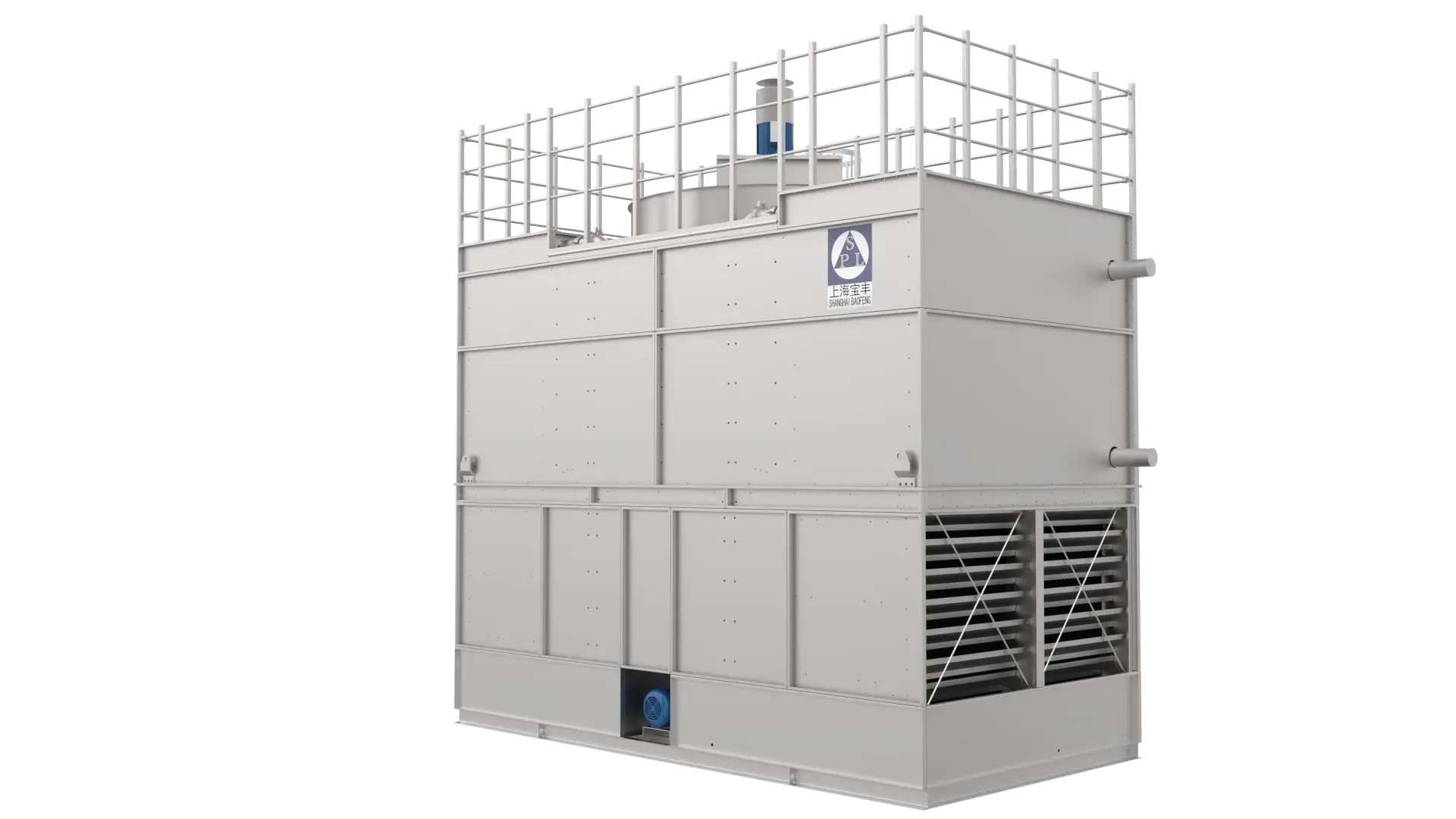
Cross-flow Cooling Towers
Product Description
In today’s industrial and refrigeration sectors, where efficiency, energy conservation and environmental protection are paramount, the T-type cross-flow evaporative cooler has distinguished itself as the preferred choice for numerous enterprises. This heat exchange equipment, integrating cutting-edge technology with exquisite craftsmanship, is dedicated to resolving condensation challenges across diverse complex operating conditions.
The T-Type Cross-Flow Evaporative Cooler integrates advanced heat exchange principles, ingeniously combining technologies such as latent heat utilisation from water evaporation and forced convective air heat transfer. This creates a high-performance condensing unit. Whether deployed in large-scale industrial refrigeration systems or commercial central air conditioning projects, it adapts precisely, operates reliably and consistently, providing sustained, efficient condensation assurance for the system.
Working Principle
The T-type cross-flow evaporative cooler represents an advanced heat exchange device developed through the integration and refinement of cutting-edge heat transfer technologies from both domestic and international sources.
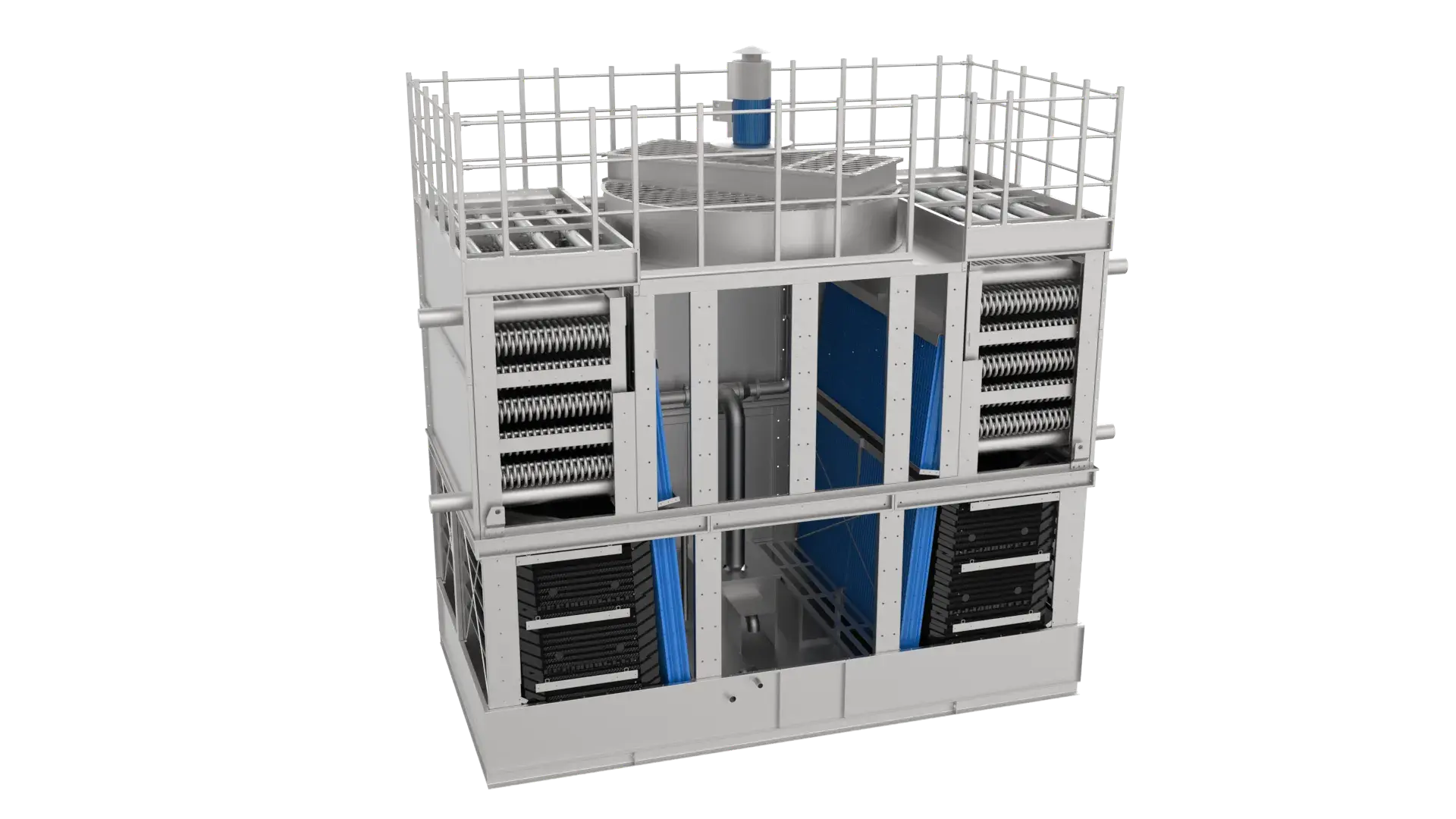
Utilising water and air as cooling media, the T-type cross-flow evaporative cooler facilitates heat exchange with high-temperature gaseous refrigerant within its coil, causing the refrigerant to condense from a gaseous to a liquid state. Its internal components include a water distribution system, condensing coil assembly, packed heat exchange layer, and water separator. Externally, it incorporates a circulating water pump, an electronic water descaler, and axial fans mounted at the top of the coil sides. The axial fans create a negative pressure environment within the unit. During operation, cooling water is distributed uniformly across the coil surface via the water distribution system under powerful airflow. High-temperature gaseous refrigerant enters from the top of the coils, where it is condensed into liquid refrigerant
exits from the coil’s base. During this process, the high-temperature refrigerant undergoes heat exchange with the water and air surrounding the coil, with the airflow significantly enhancing the heat transfer efficiency. The cooling water and air absorb heat, causing their temperatures to rise sharply. Part of the cooling water vaporises into water vapour, and this evaporation carries away substantial heat, which is drawn out by the fan and discharged into the atmosphere. Concurrently, moisture within the hot air is captured by the demister and directed into the sump. Unvaporised high-temperature cooling water flows into the packing heat exchange layer, where it is cooled by the passing air. Fully cooled water then returns to the sump, where it is recirculated by the circulation pump back into the water distribution system for continued operation. Water lost to the atmosphere is replenished in a timely manner via the float valve controlling the sump water level.
T-Type Cross-Flow Evaporative Cooler
The gaseous refrigerant and spray water flow in the same direction within the heat exchange tube bundle, typically from top to bottom. Cooling water is uniformly distributed across the packing surface via a water distribution system or nozzles, forming a thin water film. Simultaneously, negative pressure generated by fans draws external air into the tower through the packing on both sides of the condenser. This air flows horizontally across the packing layer, ensuring thorough contact with the water film. This cross-flow air pattern in cross-flow evaporative cooling enables the hot fluid to contact relatively cooler water and air immediately upon entering the tube bundle. This configuration achieves high heat exchange efficiency, allowing hot water to be cooled to the required temperature within a short timeframe.